
Model-Based Design in the AeroDef Industry - Strengthening the V-Model with MathWorks Solutions
In the Aerospace and Defense (AeroDef) industry, system complexity, safety requirements, and regulatory scrutiny demand rigorous development processes. All programs are required to comply with rigorous international safety standards like that of DO-178C, DO-254, ARP4754A, and MIL-STD guidelines, while also complying with cost and schedule targets. No easy feat!
From our perspective, MathWorks speaks Model-Based Design (MBD), powered by solutions from MathWorks. AeroDef organizations using MathWorks solutions can essentially execute the V-model efficiently, with stronger traceability, earlier validation, and reduced certification risk.
The V-Model in Aerospace & Defense
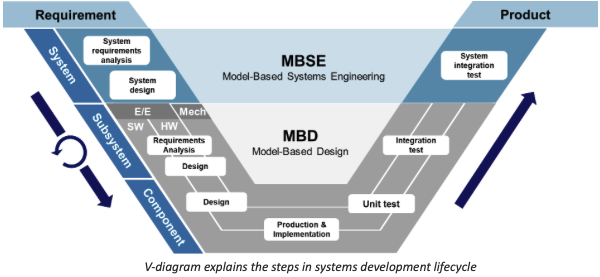
The V-model is widely adopted across AeroDef programs because it enforces structured development and rigorous verification.
Left Side of the V
- Requirements Definition
- System Architecture
- Detailed Design
Bottom of the V
Implementation
Right Side of the V
- Unit Verification
- Integration Testing
- System Validation
- Certification & Acceptance
In AeroDef, every step must be documented, traceable, and auditable. Failures in verification can delay certification and significantly increase program costs.
Where Model-Based Design Fits in AeroDef Programs
Model-Based Design strengthens the V-model by embedding executable models, simulation, and automated verification throughout the lifecycle.
Using tools such as MATLAB and Simulink, AeroDef teams can move validation activities earlier in development—often referred to as “shifting left.”
Requirements Definition & System Architecture
In aerospace systems—such as flight control computers, radar systems, UAV guidance, or mission systems—requirements can number in the thousands.
With Model-Based Design:
- Requirements can be linked directly to model elements
- High-level system behavior can be simulated before hardware is available
- Trade studies and performance analysis can be performed early
For example, control law behavior for a flight control system can be simulated under various flight envelopes long before hardware integration.
AeroDef Advantage: Early validation reduces the risk of costly late-stage design changes during qualification testing.
Detailed Design of Control & Embedded Systems
AeroDef applications often include:
- Flight control algorithms
- Sensor fusion systems
- Navigation and guidance logic
- Signal processing for radar and communications
- Autonomous mission management
Using MATLAB for algorithm development and Simulink for dynamic system modeling, engineers can:
- Model plant dynamics and environmental conditions
- Validate control stability and robustness
- Perform Monte Carlo simulations
- Conduct fault-injection testing
This reduces reliance on expensive physical prototypes and wind tunnel or flight test iterations.
AeroDef Advantage: Higher design maturity before hardware build and integration.
Implementation & Automatic Code Generation
At the bottom of the V-model lies implementation—often subject to strict certification requirements in aerospace programs.
Model-Based Design enables:
- Automatic generation of production C/C++ code from validated models
- Elimination of manual coding inconsistencies
- Traceability between requirements, model elements, and generated code
For DO-178C compliance, this approach supports structured verification processes and documentation workflows required for certification authorities.
AeroDef Advantage: Reduced coding errors, improved consistency, and streamlined certification artifacts.
Verification & Validation Across the Right Side of the V
Verification in aerospace cannot be an afterthought. Every requirement must be proven satisfied.
Model-Based Design supports:
- Model-in-the-Loop (MIL) testing
- Software-in-the-Loop (SIL) testing
- Processor-in-the-Loop (PIL) testing
- Hardware-in-the-Loop (HIL) testing
Because simulation environments are built early, test harnesses and regression suites can be automated and reused across development stages.
This continuous verification approach ensures alignment between:
- Requirements
- Design
- Implementation
- Test results
AeroDef Advantage: Improved audit readiness and reduced risk during certification reviews.
Supporting Certification & Compliance
Certification bodies require:
- Complete traceability
- Reproducible verification results
- Documentation of design intent
- Evidence of systematic validation
Model-Based Design helps generate structured documentation and maintain bidirectional traceability across the V-model lifecycle.
For defense programs, this also supports configuration control and long lifecycle sustainment.
AeroDef Advantage: Faster certification cycles and improved confidence from regulators and defense customers.
Why Model-Based Design Is Critical for AeroDef
AeroDef systems are:
- Safety-critical
- Software-intensive
- Highly regulated
- Long lifecycle (often decades)
Traditional document-based workflows struggle to manage this complexity efficiently.
By integrating Model-Based Design into the V-model framework, AeroDef organizations can:
- Validate performance before physical integration
- Reduce flight test risk
- Improve collaboration across multidisciplinary teams
- Accelerate modernization programs
- Lower lifecycle costs
The executable model becomes the authoritative reference throughout the program
Final Thoughts
In the Aerospace and Defense industry, precision, reliability, and compliance are non-negotiable. The V-model provides the structure—but Model-Based Design enables teams to execute it with greater efficiency and confidence.
By leveraging MathWorks solutions such as MATLAB and Simulink, AeroDef organizations can strengthen traceability, automate verification, and reduce certification risk—while accelerating innovation in next-generation aerospace and defense systems.
For programs where failure is not an option, Model-Based Design is no longer optional—it’s strategic.